




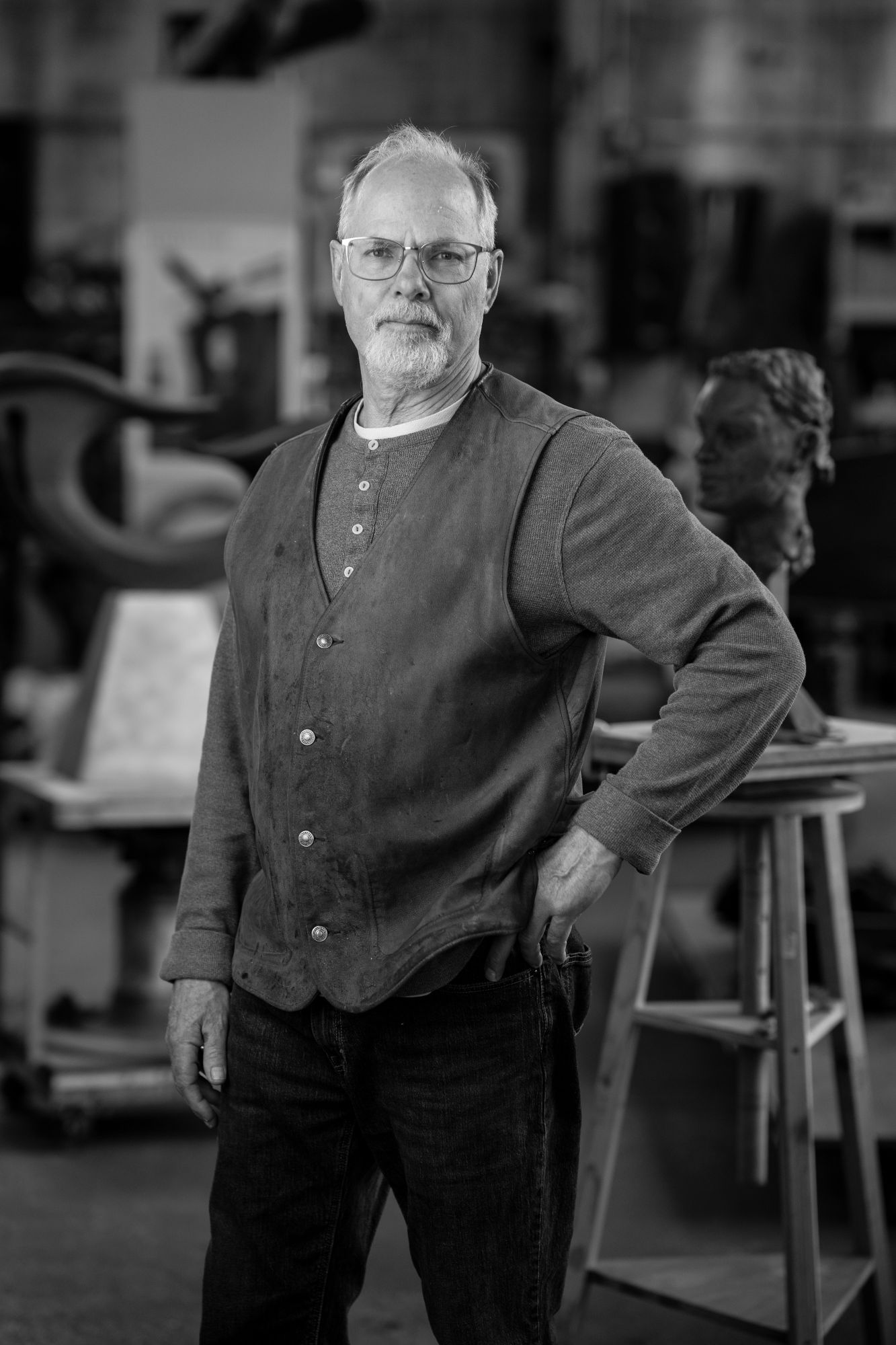
Today we’d like to introduce you to Foster Willey.
Hi Foster, please kick things off for us with an introduction to yourself and your story.
FOSTER WILLEY, Sculptor and Public Artist
I am a sculptor and public artist based in Detroit, Michigan. A relative newcomer to the city’s creative community, I moved to Motown from Minneapolis in 2019 with my wife, Valerie. I currently maintain my studio practice at 333 Midland in Highland Park. My career spans over three decades of creating sculpture and public art, collaborating on large-scale civic projects. My work integrates closely with architecture, landscape, and community, often realized in partnership with architects, engineers, designers, fabricators, and community members.
As a sculptor, I am interested in the built environment. Public Art and large-scale sculpture are exciting fields because of their range of expression and impact on our surroundings and the experience of daily life. My work as a public artist is adapted to the specifics of the opportunity. I am able to bring a range of design and fabrication skills to any public art project. My sculptural practice supplements a collaborative process that includes a community’s voice. My work is both abstract and representational. My interest in the figurative tradition and architectural ornament is central to my creative efforts. Of equal importance is the influence of the early modernist, from which my explorations into abstraction have evolved.
Animating form through the plasticity of materials and utilizing negative space to create forms that express both mass and transparency have been the focus of many of my sculptural investigations. These formal concerns inform the symbolic content of my work, which often involves the search for something archetypal, innate, and universal. It is my feeling that these qualities are relevant in the depiction of human striving and our shared lived experience. As the renowned anthropologist Levi Strauss wrote, “it is to mythologize experience in order to create the illusion of understanding.”
MENTORS / INFLUENCES
Perhaps the biggest influence on my sculptural pursuits was my Father, a successful regional artist with a somewhat traditional approach to art making. He did a lot of landscapes and loved sculpting African animals, especially rhinoceroses. I began drawing at a very early age. This early introduction has propelled me through the years. Much of my early work was an imitation of my father’s style and pedigree.
I later studied with British sculptor Allan Collins at Andrews University. Allan was versed in both traditional and contemporary sculptural traditions. Fluent in all types of sculptural techniques, the fact that he did figurative and abstract sculpture was a revelation. In the early 1980s, I trained at the Naguib School of Sculpture in Glenn Ellen, IL, with Egyptian sculptor Mustafa Naguib, where I sculpted life-size figures and numerous portraits. It was an immersive environment of traditional sculpture and a turning point where I could emulate my sculptor heroes – Michelangelo, Rodin, and Ivan Mestrovic. Returning to Michigan, I attended Kendall School of Design and then studied painting and sculpture at Grand Valley State University in pursuit of a BFA.
Around that time, my interest in abstraction deepened. While I value my early training in traditional figurative sculpture, I became increasingly interested in early modernism, especially Henry Moore and Barbara Hepworth, and in architects Louis Sullivan and Frank Lloyd Wright, particularly, their combination of organic forms and geometry in architecture and ornament. I also became interested in certain aspects of Jungian Psychology and the idea of archetypes: cultural symbols that share visual characteristics and themes across time. It is this idea of universal symbols that underlies much of my work.
I feel deeply connected to and inspired by the traditions of sculpture across cultures. A trip to the Yucatan exposed me to Mayan architecture and sculpture. Living in Grand Rapids, I worked for several years as a wood carver at Kindel Furniture, helping to recreate hand-carved reproductions selected from the Winterthur Museum in Delaware.
In 1988, Val and I moved to Minneapolis. Val attended the University of Minnesota, working towards a Master’s Degree in Fine Arts. I began cultivating my studio practice, initially working as a woodcarver. The Twin Cities of St. Paul and Minneapolis provided amazing support for artists. Together, Val and I launched our professional careers in the arts.
COMMISSIONS
In 1998, I received my first major commission from the City of Minneapolis: The Leaders Wall, a series of fifty life-sized bronze portraits of community activists integrated into the 4th Avenue Bridge along the Green Line. Nearly all the portraits were done from life, in a single sitting, and then cast in bronze. The portraits were then intermixed with a rock pattern supporting the bridge.
In 2004, I received my second major commission, for the City of Burnsville, also in Minnesota. Centrifuge is a monumental abstract bronze sculpture for Nicollet Commons Park in Burnsville, MN. The animated sculpture is the centerpiece of the park, which also includes a dramatic water feature and numerous other elements that I created for the park. At this point in time, I was working full-time in the studio and competing for other regional opportunities. I have been full-time in the studio ever since.
In 2009, I was awarded a public art commission for the City of St. Louis Park. The Bee Way is a unique sculptural plaza and gathering space. It consists of two cast stone columns, inset with a honeycomb relief pattern and terra-cotta tile. At the top of the columns are wind-activated kinetic “Swarm Sculptures” that represent the whirling flight of bees. A bee wing bench
complements the two columns, and honeycomb paving runs throughout the plaza. This was an exciting opportunity because it involved the design of a plaza, a public space, where people could interact with the sculptural elements.
My work has been recognized by the Minneapolis Committee on Urban Environment, having received two CUE awards, and the Minnesota Concrete & Masonry Contractors Association, an Award of Excellence for stone carving. The Minnesota Urban Land Institute & Sensible Land Use Coalition gave the Great Places Award to Nicollet Commons Park, which features my sculpture, Centrifuge.
In 2011 my brother, architect Guy Willey and I were commissioned to create public art for two light rail stations in St. Paul as part of the Green Line, a new transit line connecting downtown Minneapolis to downtown St. Paul: “Faces of Rondo” at the Victoria St. Station commemorates individuals, past and present, from the Rondo community who have contributed significantly to civil rights, labor unions, and regional culture. Sixteen over-life-size portraits sculpted in low relief acknowledge each person. The community was directly involved in the selection of these individuals. Prairie School Architecture inspires “Hamline Prairie Station” and draws on motifs from the work of William Purcell and George Elmslie. The station provides a modern context for the Prairie style, new designs that are both original and complementary.
Recent commissions include “Intersections” in Cottage Grove and “Streamlined Moderne” in Edina, MN. “Intersections” is a large-scale abstract work combined with an over-life-size bronze eagle as a homage to the aspirations of first responders. “Streamline Moderne” consists of two sculptures that grace the Maison Green Development. Each pairing an animated abstract form, with an ornate cast stone column that features an inset bronze relief inspired by the original Art Deco sign from the historic Edina Theater.
Since moving back to Michigan, I have completed projects, including “Vital Nature,” an abstract sculpture created for Pincanna in East Lansing, MI – a symbolic representation of Nature’s rhythmic and vital presence, and “Indigenous Oak,” commissioned by the City of Oak Park, MI, inspired by the “mighty oak.”
I also teach classes in figurative sculpture at my studio in Highland Park. The classes focus on traditional sculpting techniques and include portrait sculpture and figure studies, working from the model, with work done in terra-cotta and fired upon completion.
Currently, I am working with the Krasl Art Center in St. Joseph, MI, to create a sculpture proposed for the shores of Lake Michigan. “Lake Deity” is to be a 15-foot-high bronze sculpture aligned with the great lake. Its concentric form will connect with the summer solstice, with the sun setting directly behind the sculpture framed by its curvilinear forms. “Lake Deity” is envisioned as a striking, interactive, living monument honoring the lake’s spiritual and ecological significance. The Krasl is an advocate for the project and hopes to add it to its outdoor collection.
There is a great appreciation for sculpture here in Michigan, with all its variety. I appreciate the chance to share my story with Voyage Michigan and to contribute to that tradition.
We all face challenges, but looking back would you describe it as a relatively smooth road?
My career path has been extremely rewarding, but it has not been without its challenges. Because of the competitive nature of public art, having work in the studio all of the time is a challenge. There are a lot of talented artists out there chasing the work. As a sole proprietor, a big part of the professional practice involves applying for opportunities both regionally and nationally. Minnesota has a very robust public art program, with cities across the state providing opportunities. I entered the profession at a good time when local artists were awarded a lot of the work. However, as the field of Public Art grew, interest in national art entities made opportunities more competitive. I’m encouraged to see Michigan expanding its investment in placemaking and public art. I’m grateful to be part of that effort. I continue to pursue opportunities here in Michigan and Nationally.
Thanks for sharing that. So, maybe next you can tell us a bit more about your work?
I am very proud of my career path in terms of immersing myself in the great tradition of figurative sculpture. I really enjoy the opportunity to work from life in clay. My modeling technique is descriptive and loose. Rendered with both precision and spontaneity, the human form is observed, explored, and presented for its own sake. The experience gained in working from life provides a vocabulary of form, a source for understanding the human figure from which other ideas can be built. Our physical presence is the primary element in the built environment. A thorough understanding of the human form seems essential in creating livable communal space.
Many of my Public Art projects reference nature in different ways. These symbolic affirmations are intended to inspire and connect with the viewer, and to reflect on the natural world around us. I try to instill in many of my sculptural explorations that inner presence that animates and energizes the sculpture – the intrinsic rhythm of nature manifesting itself within the work. I believe this animated sensibility is a characteristic of the figurative tradition and the work of the early modernists, who referenced the figure in a variety of ways. It is this sensibility that I pursue in the creation of abstract sculpture.
I think one attribute that is unique in my work is the use of ornament in combination with abstraction. The abstract component is that universal symbol, while the ornamental element adds a narrative, telling the story of a particular community. In a way, ornament is a language unto itself, while abstraction is that great signifier, challenging the viewer to interpret the meaning behind the shapes, color, and movement.
As a public artist, the works created for the built environment are completed with a specific community in mind, and the community’s input can be formative. It is the artist’s task to bring a consistent sculptural vocabulary and personal vision to the opportunity. My collective work, therefore, does not represent the singular vision typical of gallery practice: instead, it reflects the growing field of “public art” that is based on competitive opportunities and community input, offering artists a way to work beyond the grant and gallery experience.
I consider my body of work original and distinct. However, I see my role in that as one contributing to something greater than oneself. a part of the process, connected to the past, inspired by others, telling the story. Creativity is a necessity, a response to our experience, reflection, and our historical moment.
Before we go, is there anything else you can share with us?
Dedication, Hard Work, and Persistence are required. Because of the competitive nature of Public Art, learning to accept rejection without being discouraged is essential.
Contact Info:
- Website: https://www.fosterwilley.com/
- Instagram: fosterwilley4
- Facebook: https://www.facebook.com/foster.willey
- Linkedin: https://www.linkedin.com/in/foster-willey-9903a712/
- Youtube: Foster Willey @FosterWilley