





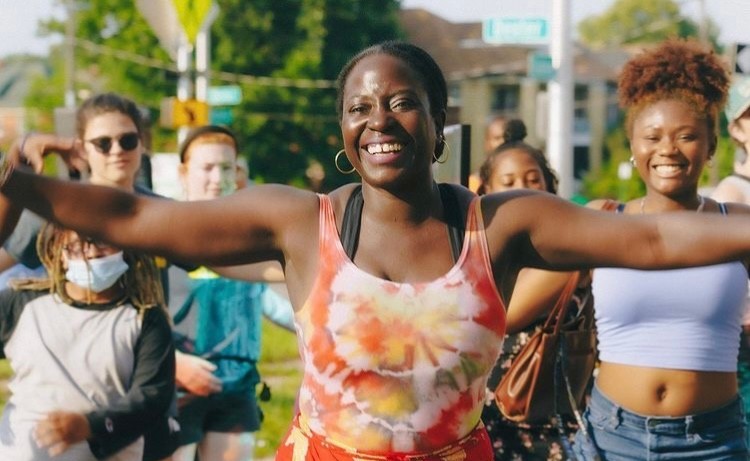
Today we’d like to introduce you to Ajara Alghali.
Hi Ajara, please kick things off for us with an introduction to yourself and your story.
Being a first-generation immigrant continues to shape my life in many different forms. My father emigrated from Sierra Leone to attend University and changed his life direction when he met my mother. During this time, my father began working for Ford Motor Company and began his personal contribution to the Motor City, Detroit. I would sometimes accompany my father to the factory and to his UAW meetings, which were 20 miles outside of the city. This was my first interaction with modern urban planning. While I am a formally educated urban planner, I never felt a connection to the profession. I always admired the arts and what art/artists make you feel.
During my childhood, I danced to music my father would curate as a DJ at his nightclub. I loved how dancing made me feel.
As I began to grow and mature, I coupled dancing for fun with dancing for educational purposes. My artistic practice centers West African dance in the classical form which I use to dismantle the systematic tools of colonization. I celebrate the rich cultural histories of African people which embody complex social norms and traditions.
As a planner, I understand how cities influence how we move, however, there isn’t much account for the humans occupying these spaces. As a cultural worker and urban planner, re-create urban spaces in the image of the black and brown people who inhabit them. I envision my work shaping the built environment and stewarding the natural. This can point us toward a future where the defining imagery of the landscape is one born from mutuality and respect for traditional customs and practices. My work as a formally trained urban planner and dance ethnochoreologist defines my guiding philosophy: there is inherent value in the informal and traditional practices people use to build community and share history.
Would you say it’s been a smooth road, and if not, what are some of the biggest challenges you’ve faced along the way?
No, it hasn’t I was blackballed by professors in graduate school for having a broader definition of Urban Planning. They also said that I couldn’t write. That was a major blow to my self-confidence, which I’m continuing to work through. People can be nasty!
Also, choosing to study and elevate the traditions of Africa is not easy. You are constantly struggling against a system that doesn’t respect the teachings and styles of African Diaspora dance and culture. You can see the disparities within academia and popular culture.
Thanks – so what else should our readers know about Culturvated & TeMaTe Institute for Black Dance and Culture?
Culturvated is an urban planning consultancy firm that focuses on project development, facilitation, and place-saving initiatives. TeMaTe Institute is a dance justice organization engaging in the vital work of cultivating dancers and culture keepers to create networks of people, places, and histories to create culture equity.
As a cultural worker, urban planner, and anthropologist, I am passionate about developing an expansive view of culture and a sustainable relationship to physical spaces. I believe this truly set me apart from others whether being an Urbanist or an Artist. My approach to how we navigate space is different, and this is what makes me excited. In both practices, we develop creative, culturally relevant programming and strategy. We identify common interests while providing opportunities for groups and individuals to learn about and celebrate their culture from a global perspective. Currently, there are two projects we need your support on. The first is a proposed place-keeping project in the West Village neighborhood in Detroit. We need votes to be able to make it to the next round, so please support us with your vote at www.tinyurl.com/mmldance. Our second project is our second conference and concert being held at Andy Arts in Detroit on October 22 and October, 23. Go to our website to get all the information on the amazing artist visiting Detroit from around the country.
Can you talk to us about how you think about risk?
I don’t necessarily think I’m a risk-taker; my risk has been believing in myself. When we are backed into a corner, that’s when we have no other option but to believe in ourselves. I could find traditional employment, so I trusted my gut and created opportunities. Don’t let others stop you, no matter what anyone thinks about your intellect or your ideas. In every rejection, there is an opportunity to learn and grow.
When those professors told me, “I couldn’t write,” while I was sad and filled with self-doubt, that didn’t stop me. I completed graduate school and leaned on friends and they became my editors. While others might want to see you fail, look to others who have your best interest at heart.
My view now is- the outcome is the same whether you failed or you didn’t try.
Contact Info:
- Website: www.tematedance.com
- Instagram: @tematedance
- Facebook: @tematedance


Image Credits
Asia Hamilton
Trilogybeats