





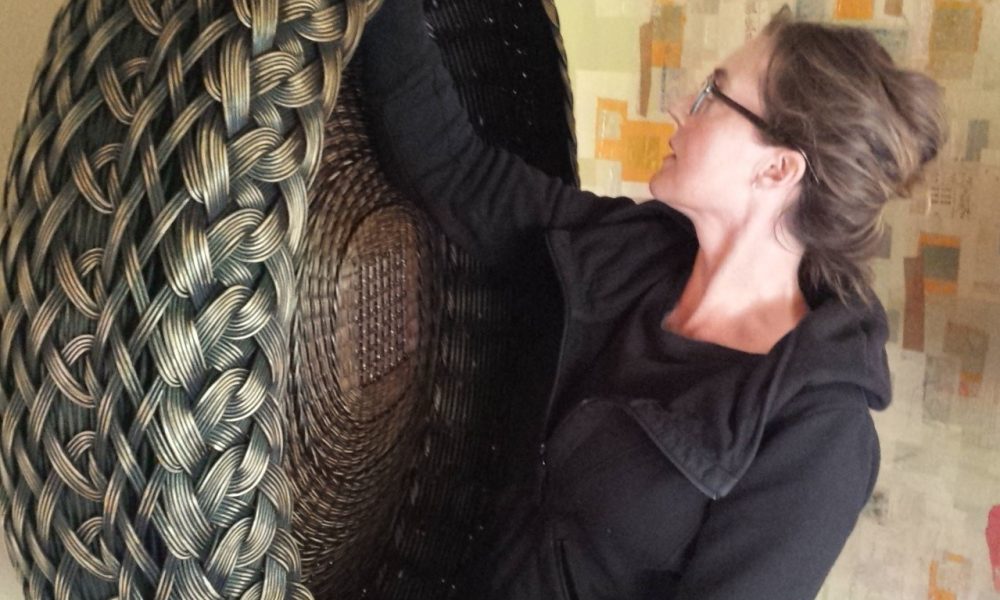
Today we’d like to introduce you to Peeta Tinay.
Alright, so thank you so much for sharing your story and insight with our readers. To kick things off, can you tell us a bit about how you got started?
I have always made things with my hands. It has always felt like a very natural extension of who I am since childhood. I come to making large-scale intricate baskets from a woven furniture restoration background which started in 1990 in Berkeley, CA. I worked at a place called The Caning Shop, which is still there and has been in business since 1969. I was there from 1990 to 2000 and worked on everything from caned seats, rush seats, splint seats, antique Japanese baskets, and teapot handles. The list goes on from here! During this time, I was also able to take basketry workshops from some nationally renowned basketry instructors and started teaching beginning basketry workshops at the shop as well.
There I also learned how to restore both antique and contemporary wicker furniture. The wicker furniture repair became my passion and focus in the restoration business. I found the complex weaving within the furniture to be fascinating. In the beginning, I started off with learning simple ways of wrapping a leg of a chair for example, and minor fixes to a broken woven area on a piece of wicker. Fast forward to the late 1990s, and I was in full swing doing re-weaves of wicker chairs. Meaning I would take some pictures of the chair in need of a reweave, make some notes, then cut away all the weaving leaving a bare frame. I learned a tremendous amount about the weaving materials, the weaving process, and finishes during my 10 years at The Caning Shop.
This gave me the backbone and structure I needed to make the basket work I do today. I use many of the same simple hand tools. The weaving materials I use are the same I used while restoring. Round reed, cane, flat reed, and whole rattan are the weaving materials and come from the same plant, the vine rattan palm. I still teach basketry workshops from beginning to intermediate/advanced level locally, nationally, and in 2016 was invited to Denmark to teach.
Would you say it’s been a smooth road, and if not, what are some of the biggest challenges you’ve faced along the way?
In 2008 when the economy took a nosedive, I had no restoration to speak of coming to me for repair. During that time, I started making large-scale baskets. It was a challenge to trust I was on the right path. Even more of a challenge to enter and be accepted to my first juried fine art show a couple of years later. The first time putting my work out into the world for everyone to see and scrutinize was nerve-wracking and exhilarating all at the same time!
Appreciate you sharing that. What else should we know about what you do?
What I do: I make large-scale intricate woven baskets from round reed, flat reed, cane, and whole rattan. After I have prepared the weaving materials for a project, I then dye them with cellulose fiber dyes. After the dyeing is completed, the materials are sorted, labeled, and dried. Then the weaving begins. After the weaving is completed a multiple-step finishing process brings highlights to the surface of the weave. This is followed up by multiple coats of UV archival varnish and an application of wax.
I teach basketry workshops and believe that a solid foundation of basic weaving techniques is key to creativity. Meaning once basic techniques are learned you can apply these techniques to almost any weaving material. The sky is the limit!
What sets you apart from others:
My work is detailed and large in scale. Some of the 42″ diameter wall pieces I make can take 2-3 months to complete. There are very few people making work like mine.
When I apply to juried art shows, I am usually the only basket maker in the mix. There are a lot of people working in glass, ceramics, jewelry, and wearable fiber art. Basketry is an underrepresented medium in juried fine art/craft shows.
That said, there are many thriving regional basketry guilds across the US, and The National Basketry Organization has a large national and international membership as well.
Contact Info:
- Website: https://www.tinaystudio.com/
- Instagram: @tinaystudio