





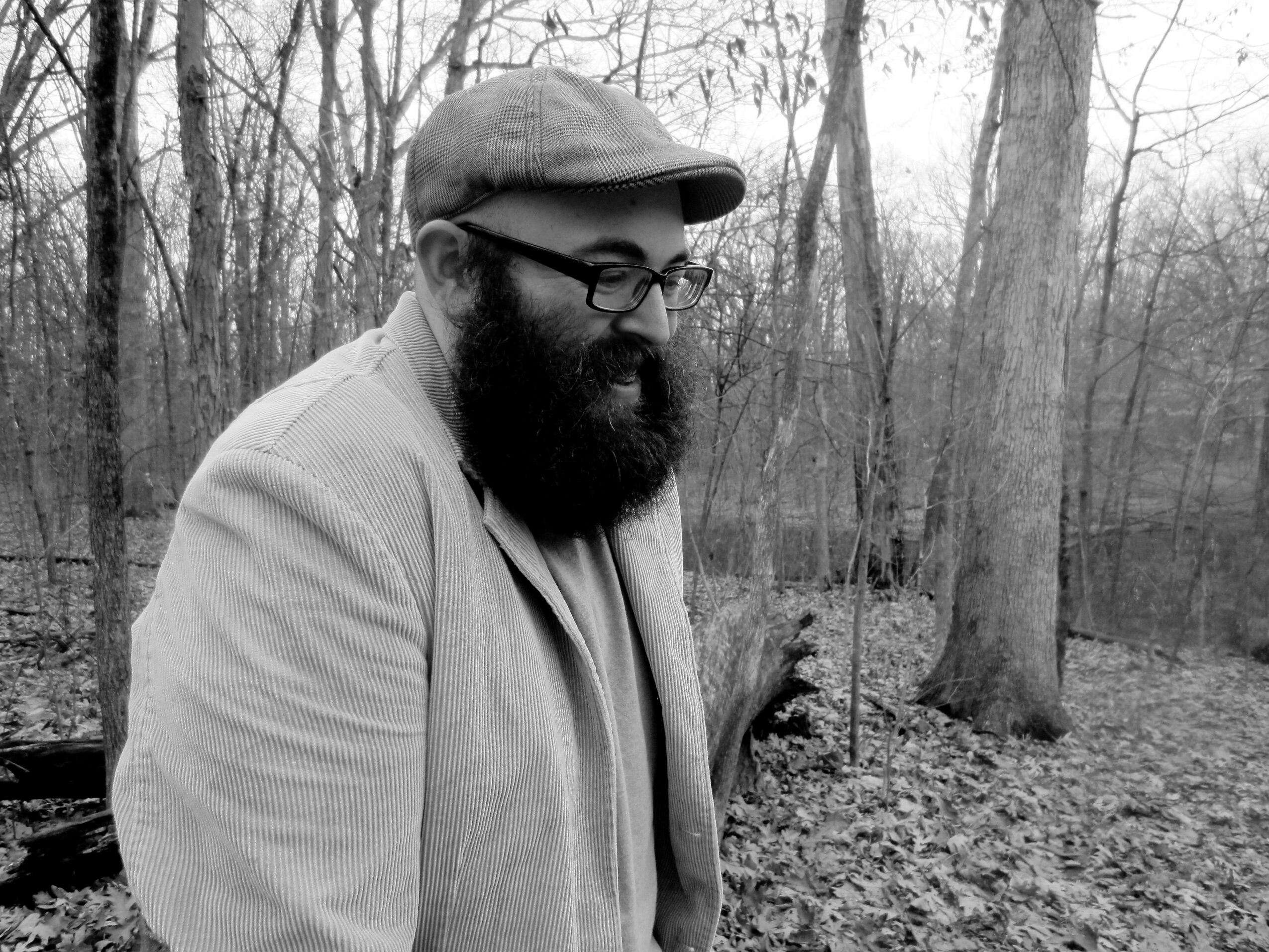
Today we’d like to introduce you to K. Edward Smith.
Edward, we appreciate you taking the time to share your story with us today. Where does your story begin?
I’m a heavy metal drummer – turned – folk singer/songwriter. And yeah, the story is about as crazy as it sounds.
When I started out, I never really thought I would be a singer. I was always the guy in the back of the band. Helping hold things together musically. Making sure everybody was having a good time. And I loved it! I was in my early 20s in the early-to-mid 2010s. Playing the underground Midwest music circuit. Bouncing around different punk and indie bands trying to find the right fit. Picking up dive bar cover band gigs to help pay the bills. Teaching some drum lessons. Doing a little session work for recordings where I could. You know, hustling and cobbling together an existence as a working musician. For the most part, it was fun! I thought that this would be what my life would look like for the foreseeable future. And I was OK with that.
But then I get a call that changes everything.
It’s a random day in 2016. A coworker at the music school where I was working pulls me aside and says, “Hey, I’ve got this friend from college who’s looking to put a band together. He’s been writing some thrashy death metal stuff, and he wants people to help him play it live. He needs a drummer, and he’s willing to pay. Can I give him your number?”
I told the coworker, “Sure.” Thinking this would just be a way to make a couple of extra bucks and have a good time. A few days later, I get a call from the coworker’s friend. It’s Tim Kenefic, the frontman of the band “Assimilator” (at the time, the band was named “Death on Fire”). Tim and I hit it off. He sends me the set list, and we schedule some rehearsals with the rest of the band to prep for the shows he has booked.
We hop in the van and hit the road. Hard.
Fast forward six years of sweaty underground shows, insane mosh pits, long days and nights on highways, and way, way, *way* too much gas station coffee… And what started out simply as a side hustle has turned into such an important part of my life.
Assimilator is now touring as far away from home as Texas, Florida, and Las Vegas. Our song “Architects” has over 31,500 streams on Spotify (and climbing). We’ve gotten to play opening slots for metal legends like Obituary and Deicide. And we’re performing at festivals headlined by bands like Exodus and Suicidal Tendencies. Not bad for a little underground metal band from Indiana.
So where does the folk music come in?
Well, during this time where we’re grinding it out in the underground scene with Assimilator, I was also diving headfirst into the world of songwriting and composition. The music school where I was working focused on performance-based music learning. As a teacher, this required me to spend a lot of time doing song analysis. Breaking songs down to their most basic building blocks so that I could help my students understand what’s going on in a piece. I’d taken music theory courses, and such in college, so I understood the language of music on an academic level. But here was a real-time, real-world, practical application. I was seeing how these theory tools actually get used to make music.
Without knowing it at the time, I was learning how to build a good song from the ground up. But I still wasn’t quite ready to call myself a songwriter yet.
Sure, I’d written a handful of tunes through the years. Songwriting was something I had been interested in since I was a kid. A couple of my teenage friends and I would jam out something awful, and I would offer lyrics. I would noodle around on the family’s old, out-of-tune, upright piano. Classmates and I would crank out some original tunes for projects in college music classes. I’d co-write as a band member in Assimilator and previous bands. But something still wasn’t clicking yet. I still didn’t see myself as a songwriter.
Somewhere along the line, I’d picked up this toxic idea that songwriting was something you either *had* or you didn’t. In my mind, songwriting wasn’t a skill that you could learn and practice. It had to be this gift given to you at birth by the Muses or something. And, of course, I didn’t feel like I possessed *the thing* that makes songwriters. So, I simply just didn’t write. Even though, deep down, I knew it was something I wanted to do.
It wasn’t until I read “Our Band Could Be Your Life” by Michael Azerrad that the wheels started turning.
The book is a primer on the American indie music underground in the 1980s. And it’s a great read for anyone interested in popular music history or anyone working in the music business. It features stories from bands like Black Flag, Minor Threat, Fugazi, Hüsker Dü, Mission of Burma, The Minutemen (one of their songs spawned the book’s title), and many other seminal underground bands. Azerrad really does justice to how these musicians just *went for it*. How they blazed a trail and built a touring circuit where there was none. How they carved out a living playing the songs they wrote. How they toured the nation in the back of an old Econoline van.
Being on the road with Assimilator, I was living the DIY work ethic exemplified by these bands. The “just hit the road and do your thing” attitude that Azerrad wrote about. And, late one night, driving home from a gig in our sweaty smelly van, I finally got it.
I realized that I could be a songwriter if I wanted to be. All it took was actually writing songs.
That sounds all sorts of obvious when it’s written out like that. But, to me, in that moment, it felt like an epiphany. It wasn’t until that sweaty van ride home that I realized it. Yes, even little old me actually has *the thing* that can make someone a songwriter. This is a skill you can practice and get better at over time. Just like playing scales on a guitar or running rudiments on a drum set.
Becoming a good songwriter isn’t about some sort of divinely gifted inspiration. It’s about sitting down and doing the work.
It took a fair amount of time before I acted on this epiphany. There was a lot of listening and practice. A lot of studying and reading. The development of an almost unhealthy obsession with Tom Waits. But finally, in the summer of 2019, I felt like I was ready to give the solo singer/songwriter thing a serious go.
I’d been writing songs regularly by this point. And I knew that I would need to start sharing these tunes with others to take my writing to the next level. The songs I was writing tended to have a folky/Americana-type vibe about them. So, I knew that it wouldn’t work to try and play these songs with Assimilator. I would need to start a solo project to feature these songs.
So, true to my punk rock/underground metal/DIY indie music roots, I decided to *just go for it*.
I challenged myself to spend the next year (June 2019-July 2020) trying the singer/songwriter gig on for size. My wife and I had just moved into our first house. There was an extra attic room, so we filled the space with a bunch of beat-up old instruments and secondhand recording gear and converted it into a studio. In addition to my responsibilities at the music school and touring with Assimilator, I kept to a strict regimen structured across a three-week cycle. Week 1: Write and record a new song from scratch. Week 2: Mix and master the song, prepping it for release. Week 3: Release the song digitally, create some promotional materials, and share with the small group of fans who were along for the ride. Rinse and Repeat.
It was madness, but I’m so glad I stuck with it.
The year-long challenge lasted 54 weeks, and I released 18 songs using that 3-week cycle. They weren’t all good. The writing and production definitely got better as the year went on – reiterating the point (and documenting proof in real-time) that songwriting is a skill that you can learn, practice, and get better at over time.
I had no problem calling myself a songwriter after starting that year. I was actively writing songs and sharing them, and I had fallen in love with the writing process. I knew this was what I wanted to keep doing, even after the year was up.
We put together a band and started doing live shows with my solo tunes in early 2021. Beginning with live stream concerts (since many venues still had Covid-related restrictions at that time) and moving more and more to in-person events as businesses started to open up. Since then, I’ve kept writing and recording new solo material in addition to recording and touring with Assimilator.
At the time of writing this, we just wrapped up our first regional mini-tour with the singer/songwriter project, “The Echoes of Summer Tour,” in July 2022. The tour was awesome! We had a bunch of dates at local microbreweries, wineries, and distilleries. The definite highlight for me was playing the first ever Vines & Harmony Music Festival. That was a blast! We’re looking forward to being on the road even more next year.
It’s time to get in the van and hit the road!
We all face challenges, but looking back, would you describe it as a relatively smooth road?
Other than the challenges shared in the first question, touring as an underground original artist is tough work. (Both in Assimilator and with my solo singer/songwriter project). It’s not for everyone. And it’s *definitely* not like the stories you hear of bands from the 70s and 80s where everything is one non-stop party.
Think less like the movie “Almost Famous” and more like the movie “Little Miss Sunshine.”
It’s a lot of long hours on the road away from home. It’s a lot of time spent in cramped vehicles (our first “tour bus” was a Chevy Malibu pulling a trailer on a wing and a prayer). It’s a lot of late-night driving home so that you can get up early the next morning to go work at a day job. It’s a lot of food from truck stops. It’s a lot of getting ripped off by shady promoters as you learn who to work with and who to avoid. It’s a lot of selling t-shirts to make gas money for the trip home. It’s a lot of playing to crowds where only three or four people dig what you’re doing when you’re breaking into new markets. It’s a lot of setting up and tearing down equipment and moving it from one place to another to do it all over again.
It’s a lot of people not really understanding why you put in all the blood, sweat, and tears to do what you do.
But those nights where it’s good, and you’re singing and playing your heart out, and the audience is connecting with what you’re doing. Man, those are magical nights, and it makes all that other stuff worth it.
And thankfully, I’m married to an incredible and supportive woman who reminds me not to make decisions based on fear. A woman who will jump in the van with us when her schedule allows. And thankfully, I’ve also got great bandmates to share the road with in both my solo project and in Assimilator.
Having good people around you like that makes the challenges of time of the road a little easier.
Thanks for sharing that. So, maybe next you can tell us a bit more about your work?
I usually call the style of my singer-songwriter music “Alt-Americana” or “Acoustic Outsider Music.” This is an attempt to communicate the fact that I’m a guy from the punk and metal worlds who now finds himself standing up there with an acoustic guitar trying to be a poet-singer like Leonard Cohen, or Nick Cave, or Tom Waits, or Patti Smith, or Bob Dylan, or John Prine, or Townes van Zandt, or Blaze Foley, or so many others.
It’s folk-influenced writing, but with an edge. Something that comes from being an outsider to the traditional folk music world.
There’s a cross-pollination between my disparate musical worlds that help nurture my music into something truly different.
So, on the recordings and in the live shows for my singer/songwriter tunes, we can have both these beautifully fragile, tender, intimate moments as well as these rowdy, psychedelic, raw moments of pure, aggressive rock’n’roll. And somehow, it all works together.
There’s some kind of cohesive thread tying all these wildly different musical moments into one unified sound. And I feel like I owe that to my unique experience of actively living in both the singer/songwriter world as well as the underground metal world at the same time.
Any big plans?
Currently, I’m gearing up (in partnership with Right Brain Records) to release a recording of an avant-garde film score I composed to accompany John J. Parker’s surreal horror film “Dementia” from 1953. The score is set to be released through Right Brain Records in October of this year (just in time for Halloween). Long term, I’d love to be able to partner with small arthouse theaters or other innovative art venues to put together screenings of the film (which is now in the public domain) accompanied by a live performance of my score.
More info on the Dementia project and Right Brain Records can be found at the following links:
https://kedwardsmith.com/dementia-the-complete-film-score/
https://www.rightbrainrecords.com/
Beyond the film score, we’re wrapping up the mixing and mastering process for a new K. Edward Smith record. It’s a concept album loosely based around the setting and characters in Ray Bradbury’s “A Graveyard for Lunatics” (a murder mystery set in classic Hollywood, written in Bradbury’s idiosyncratic style). The album is tentatively titled “Penny Picture Show,” and our goal is to release it in 2023 and do a tour in conjunction with the release.
Assimilator also has a new album slated for release in September, and we’ll be hitting the road in October and November to support that release.
More info on the upcoming Assimilator album can be found at the following link:
https://kronosmortusnews.com/2022/07/16/assimilator-release-video-for-burial-hymn/
Contact Info:
- Website: www.kedwardsmith.com
- Instagram: www.instagram.com/kedwardsmith
- Facebook: www.facebook.com/kedwardsmithmusic
- Youtube: https://www.youtube.com/channel/UC8fJ3iVrh1D4mgOksu1z9kg
- SoundCloud: www.soundcloud.com/kedwardsmith
- Other: www.kedwardsmith.bandcamp.com


Image Credits
Erin Smith