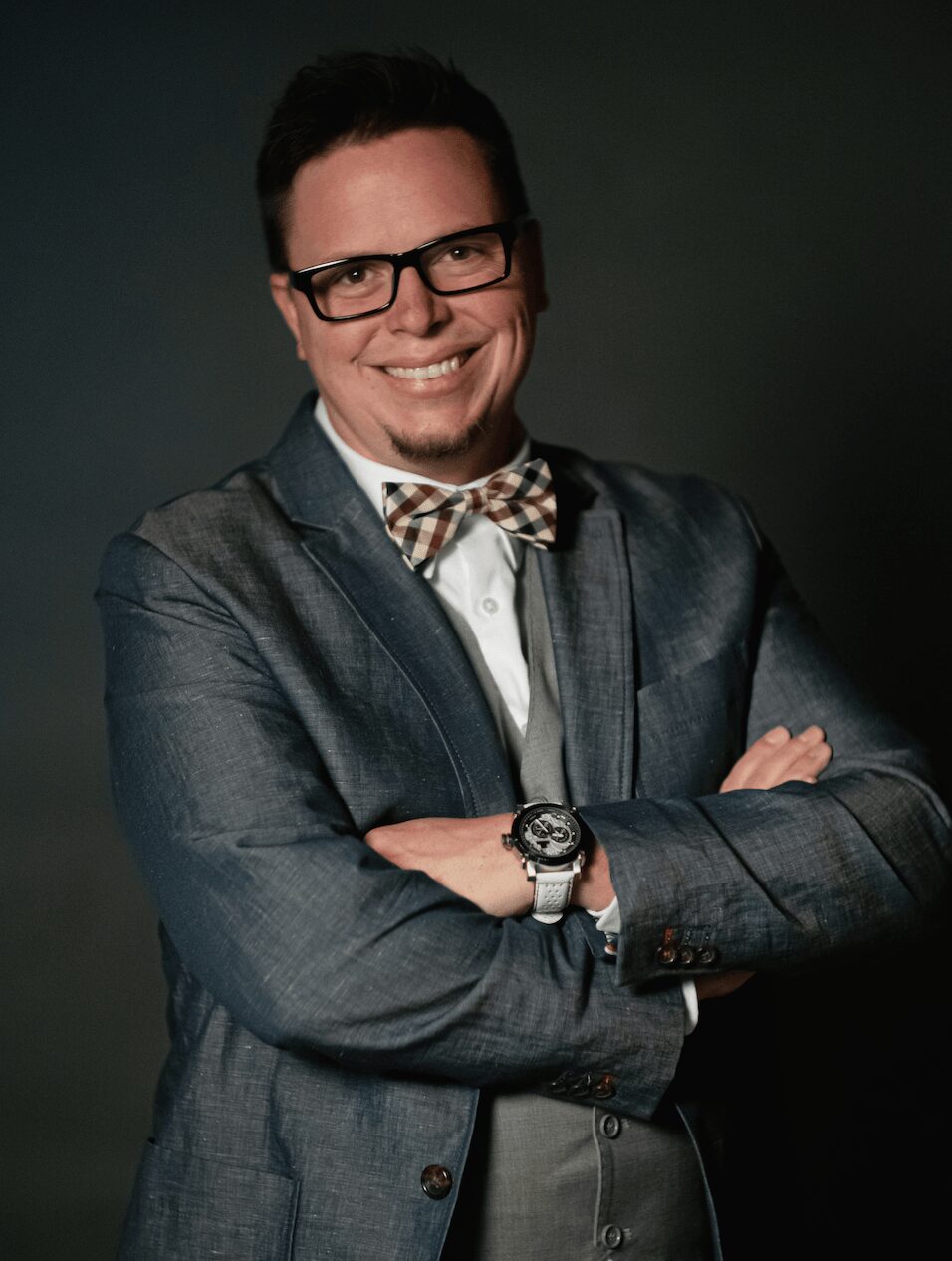






Today we’d like to introduce you to Zachariah Booker.
Hi Zachariah, thanks for joining us today. We’d love for you to start by introducing yourself.
I am a husband and father to a family who has absorbed every late night, every pivot, and every “hear me out” conversation that hijacked dinner. My wife has never asked me to stop. That kind of partnership doesn’t just support a career — it makes one possible. She deserves more credit than I’m capable of giving, and the fact that she’s still standing beside me says everything about her character and something I’m still working to be worthy of.
I’ve been an entrepreneur for as long as I can remember being anything at all.
At eleven years old, I wasn’t running a lemonade stand. I was running a lemonade stand network — multiple locations, a neighborhood operation that nobody asked me to build. What I remember most isn’t the money. It’s the feeling of making something work from nothing. Of seeing a system where others saw a sidewalk. That feeling became the operating system I’ve run on ever since.
Twenty-five years later, I’ve built more than seventy-five companies that reached revenue. I want to sit with that number for a moment, because it’s easy to hear it wrong. It is not a trophy wall. Many of those companies failed. Some failed in ways that were embarrassing, expensive, and instructive in equal measure. The industries span education, healthcare technology, real estate, financial services, staffing, media, and service businesses operating out of storefronts in small Michigan towns. I’ve built trade school systems. I’ve scaled a healthcare platform from a concept into a nationally recognized operation. I’ve owned barbershops and boardrooms, and I’ve learned that the principles governing both have more in common than most people expect.
That’s the insight I keep returning to: the mechanics of building a business are transferable.
Pricing strategy, operational discipline, capital management, hiring, leadership dynamics — these don’t fundamentally change based on industry. The principles that make a barbershop profitable are the same ones that scale a technology company. Discipline is discipline. Cash flow is cash flow. The human dynamics of leading a team don’t shift much whether you have four employees or four hundred. What changes is the complexity of the variables, not the nature of the work.
The exits I’ve had gave me something I didn’t anticipate. They gave me the freedom to stop asking what should I build next and start asking who can I help build. That question changed the trajectory of everything that followed.
Today I operate at the intersection of advisory work and active ownership. I run a holding company with multiple operating ventures, and I’ve built a fractional executive practice specifically designed to close the gap that kills good companies — the one between the senior operational leadership a growing business needs and the full-time leadership it cannot yet afford. Chief Financial Officers, Chief Operating Officers, Chief Strategy Officers, embedded in the business, not hovering above it. Operators, not consultants.
I remain an active investor and operator because I believe the best advisors never stop getting their hands dirty. What I bring to the table is not framework. It’s not theory. It’s scar tissue accumulated over a quarter century of building, breaking, recovering, and doing it again. I know what it means to make payroll by a margin that should have terrified me. I know what it costs to walk away from something you built. And I know — genuinely know — what it feels like when something finally works. When the years of grinding resolve into something real.
My purpose now is straightforward: shorten the learning curve. Share what works and, more critically, what doesn’t, so that the next generation of entrepreneurs doesn’t have to bleed for every lesson the way I did. Some lessons are worth learning firsthand. Most of them aren’t.
Twenty-five years. Seventy-five-plus companies. A patient wife who deserves a better dedication than this paragraph. Three children who keep me honest about what actually matters.
That’s the long version of the short story.
We all face challenges, but looking back would you describe it as a relatively smooth road?
Not even close. And anyone who tells you their entrepreneurial journey has been smooth is either describing someone else’s story or hasn’t been at it long enough to know what’s coming.
When you’ve built more than seventy-five companies, you don’t arrive at that number by winning consistently. You arrive there by refusing to stop when you lose. And I have lost — in ways that were costly, humbling, and on a few occasions, genuinely devastating.
I’ve poured everything into businesses that simply didn’t work. I’ve made hires I was certain about that turned into expensive, painful mistakes. I’ve mispriced services, underestimated competitors, overestimated markets, and extended trust to people who hadn’t earned it. I’ve moved too fast when the situation demanded patience and sat too still when speed was everything. The mistakes don’t come from one direction. They come from all of them, often at once.
One of the sharpest lessons came from a counterintuitive place: growth nearly broke me before failure ever had the chance.
Early in my career, I operated under the assumption that the goal was always more — more revenue, more locations, more headcount, more deals. What I didn’t yet understand is that growth without the infrastructure to support it isn’t success accelerating. It’s collapse in disguise. The faster you grow without the right foundation, the harder the eventual reckoning. I had to learn that lesson more than once before it finally took.
Cash flow is where entrepreneurship gets honest. There is a particular loneliness to staring at your accounts on a Tuesday night, knowing payroll is Friday and the margin isn’t there yet. You can’t bring that weight to your team. You don’t always want to bring it home. So you carry it. You solve it quietly, alone, and then you do it again the next time the math doesn’t work. I lived on that edge longer than I should have, and it cost me more than money. What it eventually taught me — at a price I wouldn’t recommend — is that margin is not a luxury. Discipline in the numbers is what makes everything else possible.
Knowing when to stop has been one of the most difficult skills I’ve ever had to develop.
When you build something, it becomes part of your identity in ways that aren’t always healthy. Walking away from a business that isn’t working feels, in the moment, like conceding defeat. It took me years to understand that releasing the wrong thing is what creates the space and the clarity for the right thing. Some of the best moves I’ve ever made weren’t what I chose to pursue. They were what I chose to stop. Learning to make that distinction without ego in the way — that’s still a practice, not an achievement.
The personal cost deserves to be named plainly.
Twenty years of marriage running alongside twenty-five years of entrepreneurship means my wife has seen me at my worst more times than I can account for. Distracted, stretched beyond capacity, present in body but absent in every way that matters. There were seasons where I was not the father or the husband I had committed to being because I was consumed by whatever I was building at the time. I’ve had to reckon with that honestly and continue to. The businesses will always demand more than you have. They are not designed to self-limit. Learning to set boundaries and actually hold them under pressure has been one of the hardest disciplines of my professional life, and one I’m still refining.
There is also a mental weight to this work that rarely gets discussed with enough candor.
Entrepreneurship is culturally glorified. What the highlight reel omits is that most of the actual experience is managing uncertainty, making consequential decisions with incomplete information, and solving problems that weren’t visible when you signed up. That sustained pressure accumulates. I’ve had seasons of real burnout — periods where I questioned the purpose of the work and whether the cost was worth what I was building toward. What carried me through those stretches wasn’t resolve for its own sake. It was the clarity of knowing why I had started and the grounding that comes from the people in your life who believe in what you’re building, especially in the moments you aren’t sure you do.
The road has been anything but smooth. I wouldn’t characterize it otherwise, and I wouldn’t want to.
What I can say is this: the hard seasons built more of who I am than the successful ones ever could. Every failure produced something a win never would have — clarity, humility, and a more sophisticated understanding of what actually matters. The person I am today as a leader, as an advisor, and as a husband and father was forged almost entirely in the difficult chapters. I am grateful for the exits and the successes. But I am who I am because of everything else.
Appreciate you sharing that. What should we know about Carlew Capital / Executive District?
At the center of everything I operate is Carlew Capital, the holding company that oversees and runs multiple ventures across industries. It is the structural engine behind the portfolio. But if you want to understand where we are making the most meaningful impact right now, the answer is Executive District.
Executive District is a fractional C-suite advisory firm — and I want to be precise about what that actually means, because the category is becoming crowded with people who use similar language to describe very different things.
We provide growing businesses with embedded, senior-level operators. Chief Financial Officers. Chief Operating Officers. Chief Strategy Officers. The kind of leadership that a company in the growth stage desperately needs but cannot yet justify at full-time compensation. That gap — between the startup phase a business has outgrown and the scale at which a seven-figure executive team becomes rational — is where some of the best companies quietly stall. Capital stops flowing efficiently. Operations break under their own weight. Strategy becomes reactive rather than intentional. The founding team, which was built for launch, gets asked to carry a fundamentally different set of demands without the infrastructure to support them. That is exactly where we step in, and it is the problem we were built to solve.
The distinction I will draw repeatedly, because it is the one that matters most, is this: we are not consultants.
Consultants diagnose and recommend. They present findings, propose frameworks, and leave. What happens after the engagement ends is rarely their accountability. Executive District operates on a different premise entirely. Our operators embed inside your business. They sit in your meetings, build your financial models, restructure your operations, develop your strategy, and hold your team accountable to execution. They carry the weight of the role, not the appearance of it. The difference between advice and execution is not semantic. It is the difference between a business that improves and one that transforms.
What makes this firm credible beyond the model itself is the experience behind it.
When you have personally built and operated more than seventy-five companies across industries as different as healthcare technology, education, real estate, financial services, and neighborhood service businesses, you develop a pattern recognition that is not teachable in a classroom and not replicable by someone who has only ever operated in one domain. We have seen what breaks a four-person service company and what breaks a company doing eight figures in revenue. We understand that the principles governing both are far more similar than most people expect, and that understanding is what allows us to move fast and accurately when we enter a business.
I also remain an active operator and investor alongside this advisory work, and that is not incidental. It is by design. There is a credibility gap that exists in the advisory world between people who teach and people who do. We insist on doing both. Every recommendation we make to a client is grounded in something we have either executed ourselves or are executing right now inside one of our own portfolio companies. That keeps our thinking sharp, our advice honest, and our operators relevant in a way that a purely advisory practice simply cannot sustain over time.
What I am most proud of, from a brand perspective, is not a product or a service. It is the trust we have been given.
We enter businesses during some of their most consequential moments. When a founder opens their financials, their operations, their internal conflicts, and their strategic uncertainty to an outside operator, they are offering something that goes well beyond a professional engagement. They are extending real trust at a moment of real vulnerability. We do not treat that lightly, and we have never built this firm around volume. Our reputation has been constructed one relationship at a time, and every engagement we accept is evaluated by a single standard: did we actually move the needle for that business? Not how many hours were billed. Not how comprehensive the deliverable was. Whether the company is measurably better for having worked with us.
If there is one thing I want readers and potential partners to understand about Executive District, it is this: the most capable entrepreneurs I have ever worked with were not the ones who had every answer. They were the ones who were honest enough to know what they were missing and decisive enough to bring in the right capability at the right time. That is what we are built for. We show up when it matters, with the experience to make a genuine difference, and we stay until the work is done — not until the engagement expires.
We help you build something that can carry its own weight. That is the work. That is the brand.
Do you have any advice for those looking to network or find a mentor?
The best mentor I ever had didn’t know he was my mentor for the first two years.
I never asked him. There was no formal arrangement, no monthly check-in, no structured agenda. I simply paid close attention. I watched how he made decisions under pressure, how he handled conflict when it was costly, how he talked about money when the stakes were real, and how he treated people when absolutely nothing was on the line. That last one told me everything worth knowing. What I absorbed from proximity to that man shaped how I operate more than any deliberate instruction ever has.
So my first piece of advice is this: stop waiting for someone to sit across from you once a month and review your business plan. That version of mentorship exists, and it has its place, but it is not the only form and often not the most powerful one. The most significant learning I have ever done from another person was observational. Find people whose results you genuinely respect. Get close enough to study how they operate — not just what they decide, but how they think, how they carry uncertainty, how they behave when nobody is watching. Patterns reveal themselves to people who are paying attention. Most people aren’t paying close enough attention.
On networking, I’ll say plainly: I wasted years doing it wrong.
I attended the events. I collected the cards. I had the surface-level conversations that felt productive in the moment and produced nothing afterward. That is not networking. That is socializing with a lanyard on, and I did it long enough to know it generates almost no return on the time invested.
What finally worked — and what has driven every meaningful professional relationship I’ve built over the past decade — was a single shift in orientation. I stopped walking into rooms asking “who can I meet” and started asking “who can I help”. That change sounds simple. Its effect was not. When you enter a room, an industry, or a conversation genuinely looking for ways to create value for the people in front of you — without keeping score, without an immediate agenda — the right relationships find you. People remember, with remarkable clarity and for a remarkably long time, the person who helped them solve a problem. They do not remember the person who handed them a card and recited their services.
The other principle I have come to hold with conviction is that the goal of networking is not breadth. It is depth.
I would rather have fifteen people who take my call at ten o’clock on a difficult night than fifteen hundred connections who wouldn’t recognize me in a parking lot. Depth of relationship is what produces real opportunity, genuine partnership, and meaningful support when things get hard. And in entrepreneurship, things always get hard. The width of your network may open doors. The depth of it determines what happens when you walk through them.
For anyone specifically trying to find a mentor, here is what I have learned from both sides of that relationship: do not lead with the ask.
Approaching someone you admire with “will you be my mentor?” puts them in the position of committing to a relationship they have no basis yet to evaluate. It creates obligation before there is connection, and it almost never works. What does work is proximity developed with patience. Find where they are. Engage seriously with their thinking. Ask one question that demonstrates you have actually done the work. Offer something genuinely useful with no expectation attached. Let the relationship form at its own pace. The best mentorships I have been part of — on both sides — were never named. They emerged from consistent, mutual respect over time, and they became something real precisely because neither party forced them into a structure before the foundation was there.
I would also encourage people not to limit their search to mentors inside their own industry. Some of the most clarifying perspectives I have ever received came from people who had no proximity to my businesses at all. They could see what I could not see because they weren’t close to it. Distance from your specific context is not a disqualifier. In many cases, it is the value. A great mentor does not exist to validate your plan. They exist to challenge your thinking — and that requires someone willing to see it clearly, which insiders rarely can.
Networking and mentorship are long games. They do not reward urgency, and they are not accelerated by transactions. They compound slowly, through consistency, generosity, and follow-through — year after year, without keeping score. The depth of relationship that builds over that kind of time is one of the most durable competitive advantages available to any entrepreneur. It cannot be purchased, manufactured, or shortcut.
Show up. Add value. Follow through. Do that long enough and the relationships you’ve been looking for will have been building around you the entire time.
Contact Info:
- Website: https://carlewcapital.com
- LinkedIn: https://www.linkedin.com/in/zachariahbooker/
- Other: https://executivedistrict.com