





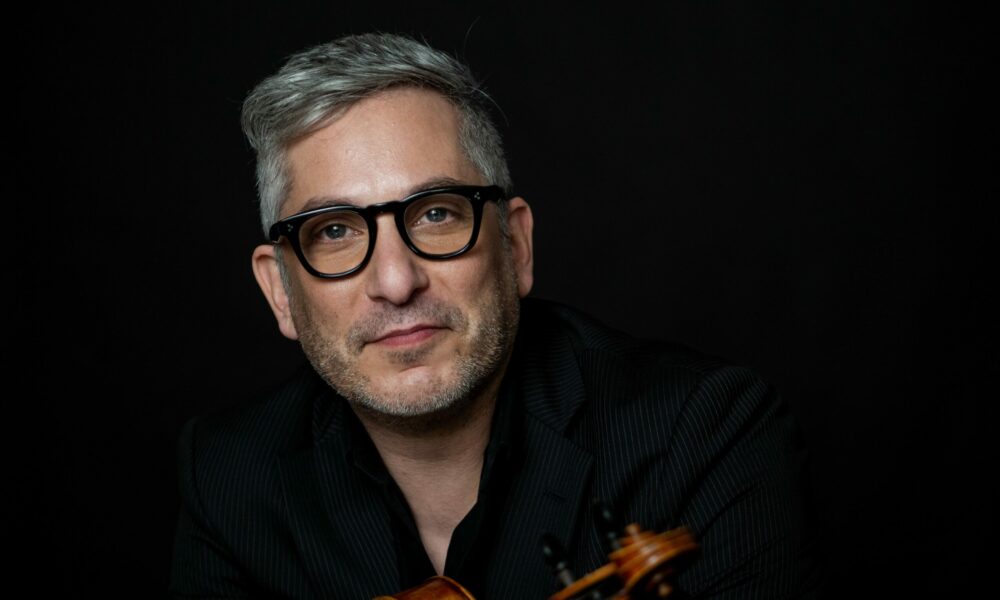
Today we’d like to introduce you to Gabriel Bolkosky.
Alright, so thank you so much for sharing your story and insight with our readers. To kick things off, can you tell us a bit about how you got started?
My father was a Holocaust historian for most of my childhood until his death in 2013. He spent so much time studying the event and all that culminated and resulted before and after I’m certain it was hard on his emotional life. He wrote about it, taught about it at the University of Michigan for decades, and interviewed hundreds of survivors. What affected him most deeply was not just the gruesomeness of the event but the apathy and hatred that created it. I am not sure how he managed his inner world as a result. I’m fairly certain that he found relief in two main places- his family and music. Musical relief for him came in the form of all kinds, particularly jazz, but also classic rock and classical chamber music. This was the sound world where I grew up. And a beautiful sound world it was. Diverse, rich, and filled with incredible collaborative music-making.
When I was three years old, I was gifted a pair of drumsticks. I had likely seen and heard a number of violinists even at that young age and decided to pretend that the drumsticks were a violin and bow. I put one under my chin, closed my eyes, and pretended to play the beautiful music that had filled my house and soothed the sadness I sensed in my father. My parents took that as an indication that it was perhaps time for violin lessons, and so began my journey into the world of music and violin playing.
As I got older, I found immense joy in sharing my music with audiences and friends. I especially liked making people feel the deep empathetic joy that I felt inside when I would listen to the great works in classical, jazz, and rock music. I wanted to bring to the audience the same feelings from the gentle kindness and passion of the Tchaikovsky violin concerto, the joy and optimism of a Milt Jackson solo, and the immense depth of the late Beatles studio work, just to name a few. It gave me a feeling of value and purpose to help others feel happiness and deep emotion. This led to a decision to become a professional musician. My musical path was a winding one, moving primarily through chamber music, jazz, and the music of Astor Piazzolla.
As I matured, I realized that my admiration for my father’s work was stronger than I thought. I found myself wanting to find a way to continue his work without lingering in the horrors of genocide. I decided that if he studied the disease of society, I wanted to study health by dedicating a great deal of my time to creating nurturing environments for people of all ages to learn music, culminating in a music festival called PhoenixPhest, which I ran for 20 years. I found some of the most dedicated artists and teachers who were also interested in nurturing all levels of players: Peter Salaff, Don Weilerstein, and Martha Katz of the Cleveland Quartet, Mari Sato, Annie Fullard, Merry Peckham, and Kirsten Docter of the Cavani Quartet, as well as great pedagogues such as Mimi Zweig, Simon Fischer, Almita and Roland Vamos and many others from around the country. Access to these teachers usually required high-level auditions and a great deal of money. Through my nonprofit we were able to help musicians of all levels have a chance to learn from these wonderful beacons of the art form in a non-competitive setting. I feel hopeful that it contributed in a meaningful way to a hundreds of dedicated musicians, young and old.
During the pandemic, we were forced to shut down the festival, and I was faced with the dilemma of how to continue to help the arts education community. What I quickly realized through working with people on Zoom was the root of most educational issues. It was an unexpected find, but led me to a new path of service in the educational space- emotional regulation. Most people, when in the digital space, were experiencing a great amount of anxiety. As a result, they had little to no patience with themselves or the material they were learning.
I decided to create a new online program to help people through the difficult time. It is a system of moving through musical instrument practice in a way that encourages process, emotional regulation, and community. The community has grown over the years and has logged thousands of hours of practice together. What makes me feel most proud of it is that not only are people practicing for longer and with less frustration, they are able to carry a sense of calm and process into the rest of their day in a way that helps them. My hope is that with my company, Education For Happiness, we are able to create spaces like this for multiple subjects allowing for people to gain benefit from any subject they decide to immerse themselves in.
Alright, so let’s dig a little deeper into the story – has it been an easy path overall, and if not, what were the challenges you’ve had to overcome?
Oh the smooth road! Though it feels easier and more pleasant, a smooth road is not always great for fostering creativity. It is the obstacles, the blocks, that demand creativity. In a sense, as an artist, you are always dealing with obstacles and challenges. Being blocked is often where the creativity begins. This may be one of the most difficult practices for me personally because it often requires that I change my thinking or change myself. So, I search for the blocks that require me to change myself for the better and find a calm center to do inspired work. It’s a balance of inspiration and peaceful learning.
In my experience with music, those obstacles have mostly involved learning to soften and be more vulnerable to other people and their ideas. Friendship is, I believe, above all, the most important thing in life. More important than art. So, this is a challenge that I face now: I cherish the close friendships with friends and colleagues that I have while being open to creating more friendships. It is an unexpected challenge for me as an artist, but one that has made me a better collaborator, a better husband, and a better friend.
Thanks – so what else should our readers know about Education For Happiness?
Education for Happiness, besides being the name of my company, is an approach with a core value that successful learning should feel satisfying and relevant to each learner. That feeling of satisfaction brings the learner back to learning again and again. Happiness is, of course, a loaded word! It can imply a temporary feeling that comes and goes, but I think of happiness as more of a general feeling of fulfillment from an approach to life and lifelong learning. Like making soup, you need certain ingredients in order to achieve that fulfillment. Those ingredients include a feeling of calm and safety, a sense of unhurried process, and consistency with whatever material is being studied. We aim with each of our programs to foster that approach to learning.
So, at Education for Happiness, we try to reverse engineer the learning process to make sure that the end result is satisfaction or a feeling of being glad for the time spent. Our latest program, Rollin’ Practice Support is a daily program (2-3 sessions per day) allowing for musicians to practice in a community while moving at their own pace based on careful principles that we lay out for them. We divide the practice into six notions: Centering, Connecting, Planning, Experiencing, assessing for benefit, and putting away. The process is repeated 3-5 times in one hour, resulting in an experience that feels deeply satisfying. Many of our clients have reported feeling a sense of satisfaction not just with the hour but with the emotional regulation that it helps them carry into the rest of their day.
We encourage and include emotional regulation exercises before, during, and after learning activities. The core value is that each learning subject (music, art, math, literature) has benefit at any level of understanding. The more we can instill that value, the more potential there is for growing intelligence and awareness in a person. They become aware of the totality of things by valuing learning and understanding above specialization. Paradoxically, this leads to better problem-solving and more skilled individuals. Ultimately, it leads to a well-rounded and happy life.
I continue to have a performing career with two main groups: The Bayberry String Quartet www.bayberrystringquartet.com and The Oblivion Project www.oblivionproject.com
What does success mean to you?
I believe that success is a mindset. As I keep mentioning, I believe it is a feeling of satisfaction with time spent. For those of us who grew up as over-achievers, always wanting to better ourselves, to be the best, this can be dicey. We always strive to be better, and therefore we never feel quite satisfied. I have found that even when a project or performance has been “successful,” I might still feel pretty badly about it because I have conditioned my mind in assessment to be very critical rather than seeing the benefit of time spent and being grateful for what I have received as a result. It is a tough line to walk for those of us who really desire to contribute something valuable but also want to feel success – satisfaction at having done something valuable for oneself and others.
For me, success has become a constant practice as I’ve aged. I aim to feel happy about the time I’ve spent in personal practice, with loved ones, and with my work. I also aim to have a sense of faith that the time I am planning to spend will be satisfying in those spaces as well. It takes a great deal of emotional regulation and care, but what I hope most is that this practice will make my life more meaningful and more valuable to others in order that I might serve them and share with them to the best of my abilities. Then, I know that each moment was worthwhile.
Pricing:
- Daily online Practice Support is $89/month
Contact Info:
- Website: www.RollinPractice.com
- Instagram: www.instagram.com/rollinpractice
- Facebook: https://www.facebook.com/rollinpractice
- Linkedin: https://www.linkedin.com/in/gabriel-bolkosky/
- Youtube: www.youtube.com/@bayberrystringquartet
- Other: https://gabrielbolkosky.com/listening-room/


 Image Credits
Matt Dine
Derek Snyder
Mau Quiros