



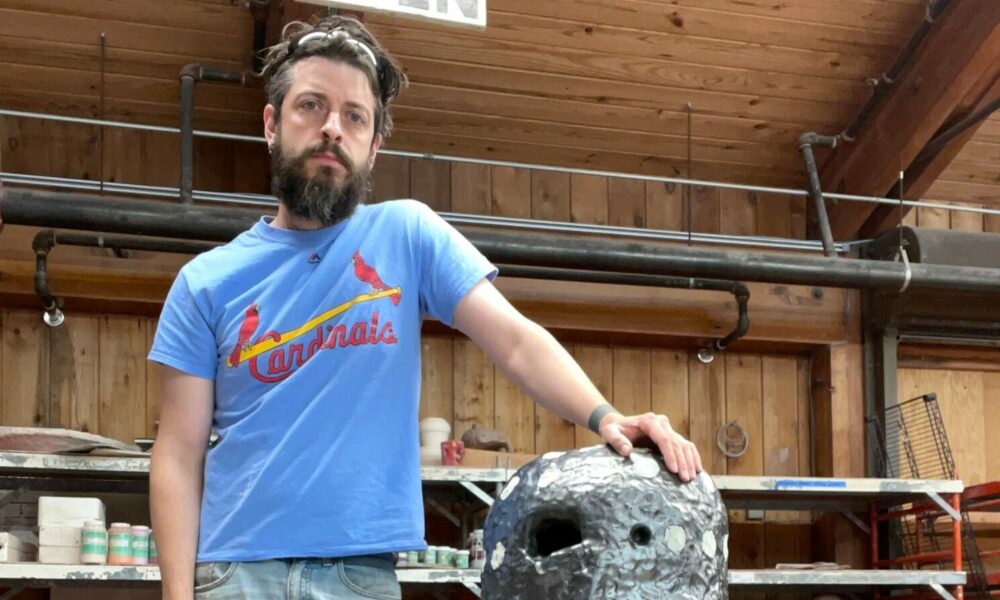
Today we’d like to introduce you to Zach Tate.
Hi Zach, thanks for sharing your story with us. To start, maybe you can tell our readers some of your backstories.
Oh… that might be a small novel. The short of the long goes like this: I am originally from the Ozarks in Southern Missouri. I come from a long line of teachers and farmers who are/were not artists by trade. After high school, I went to Ozarks Technical Community College to get a start on a biology degree when I ended up in an art appreciation class that I needed for my transfer degree. That class, and professor from that class, changed my life. He encouraged me to change my degree and transfer to Missouri State University to pursue a BFA, which I did.
After graduation, I received a grant and an offer to move to Taiwan to be a resident at the Tainan National University of the Arts in Taiwan. This led to several years of international living and travel in Japan, Denmark, and Sweden until I deiced to apply for graduate school in the states. I was accepted to several programs but ultimately decided on Texas Tech University in Lubbock. This itself was a pretty wild and fruitful experience in getting my MFA.
Along the way, I met my wife on an art-related trip through northern Indiana. After graduation, I moved to northern Indiana and accepted a position at the University of Notre Dame as a visiting lecturer and Research Associate in the Ceramics Department. This led to my wife and I to found an art outreach and community studio non-profit organization called Goshen Community Arts. We offered classes, studio access, after-school programming, and collaboration with area schools and the juvenile detention center to youth and adults throughout northern Indiana.
In 2019 I accepted my current position at Northwestern Michigan College as the head of ceramics and art history. Subsequently later that year the pandemic forced the closing of Goshen Community arts and that chapter in my career in Northern Indiana.
Can you talk to us a bit about the challenges and lessons you’ve learned along the way? Looking back would you say it’s been easy or smooth in retrospect?
It has been anything but “smooth” but extremely exciting (I can say that now that I am standing on two feet). Making a career in art is not for the faint of heart. I spent most of my adult life with little to no money, working multiple jobs in construction, housing maintenance, adjusting while a visiting professor… etc. I knew from the start that I would never be a production artist. I just do not have it in me to make work in that manner (I will add there is nothing wrong with it. It just isn’t me). So, making a living solely off of my art was a pretty far stretch. But I did know that I wanted to work with community and that teaching at the post-secondary-education level was of great interest to me.
In the middle of all of this, I got married and had a daughter and stepson. Prioritizing my personal life while also pushing a professional career as an artist and educator is tasking. It would not be possible without sacrifice… mostly from my wife who is extremely supportive.
Can you tell our readers more about what you do and what you think sets you apart from others?
For the majority of my career, I worked with figurative political commentary through clay. My thesis in graduate school was titled “Political Discourse”. It featured 30 busts of contemporary and historical political figures throughout the world. This theme was pretty central to my identity as an artist and it satisfied my need to make statements about our political zeitgeist.
However, after the 2016 election, my work took a dramatic turn. It seemed like everyone was now deciding to become a “political artist” and I didn’t feel like weighing into the collective shouting match. I began to remove myself from pure sculpture and began to work within the vernacular of pottery. I started making cups that were in the shape of skulls. They were indiscreet and could be male, female, black, white, Asian… etc. They became less about the person and more a commentary on the collective humanity, the need for connection, and ceremony. I am still working in that vein today, but the work has grown into something more narrative at this point.
The crisis has affected us all in different ways. How has it affected you and any important lessons or epiphanies you can share with us?
I have learned to slow down. I used to work at a breakneck pace in making and living. During the entire pandemic, I showed up to work every day and taught reduced-sized ceramics classes in person at Northwestern Michigan College. I was one of only a few professors who held in-person classes at the beginning. It was certainly a risk, but it seemed worth it. I had students who really needed to get back in physical proximity to others, some who needed a cathartic avenue, and others who were just driven to continue their art-making paths. Regardless of politics, all students had to wear masks, follow cleaning protocols, and trust that their fellow colleagues were doing the same. It was certainly scary at times, but all in all, it was a great experience to have in such a horrible time.
Contact Info:
- Website: www.zachtateceramics.com
- Instagram: @zachtate_artist
- Other: https://companiongallery.com/shop/zach-tate/


Image Credits
Ramiro Rodriguez
Dennis Sipiorski